


For a refresher on the different types of buying signals and why they matter, check out Part 1 of this guide.
Spotting intent data is only half the battle; the real difference-maker is what you do with it.
When a meaningful signal occurs, you should be ready to quickly follow up with a relevant, personalized message or a phone call. Yes, picking up the phone right away can be extremely effective!
But what makes a signal meaningful? And how can you craft your messaging with the right value proposition and tone?
Today, we'll discuss how to act on buying signals in real-time, allowing you to turn raw intent into booked meetings and ensuring you never miss a high-intent prospect again.
Prioritize and Score Signals
With so many different types of potential signals, it's critical to create a strategy for what to do with each one depending on the signal itself, the fit of the target account, and any prior context.
First, set up a scoring system for what constitutes a strong signal versus a mild one and determine actions accordingly. For each signal, you should define why it matters based on your company's market, constraints, and needs.
Tip: Signal Stacking
Considering multiple signals together can make them even more meaningful.
For example, a single website visit, cold email opened, or video ad watched might not be enough to trigger an action. But if an account completed all three this past week, it becomes clearer what they're interested in and there is a stronger reason to reach out.
Many platforms consolidate activities into a unified account timeline – from ad clicks to web visits to champion moves – all in one place. A cluster of different signals around the same time suggests the need to act decisively. This helps reps connect the dots, but in practice this can be difficult to do manually (AI can help with this, as we'll discuss).
Example Plays
Signal Priority Table
| Signal | Priority | Notes/Actions |
|---|---|---|
| A target account in your ICP visiting your pricing page multiple times and screenshotting it | Highest | Capturing a screenshot of your pricing page suggests the prospect is sharing it internally or comparing options. Reach out ASAP while you're top of mind. |
| A champion switches jobs to a company with newly raised Series B funding | High | A perfect warm outbound opportunity. Give congratulations and explore new opportunities. |
| Just hired a new role relevant to your product, and they visited your site | High | For example, if you sell a cybersecurity product and a target company hired a new CISO who has shown early interest, it's the perfect time to reach out. |
| Multiple cold emails or newsletter opens and clicks | Moderate | Repeated email opens without a click suggests curiosity. Consider sending a different CTA or soft ask. |
| Relevant news, blog posts, or announcements by a target company | Moderate | For example, if you sell an AI developer tool and a company just launched a new AI product, they may have just entered the market for your product. |
| A single webinar sign-up from a lower-fit company | Moderate-low | Place company in a nurture track and do more research as needed. |
| Liking a social media post from your company | Low | Passive actions such as likes and shares show topical interest. Use this signal for soft-touch outreach or to warm up colder leads. |
Ideally, you'll want to create an account score that includes the signal strength, prior signals and engagement, and how closely the account matches your target ideal customer profile (ICP). That way your sales reps can simply sort on that score to find the best leads across the entire market.
Depending on the complexity of your target market and sales organization, creating accurate and useful account scores can be a challenge. Traditional scores are points-based - meaning that an email click might be worth 5 points, and a pricing page visit worth 20 points. The downsides of this method are that point values tend to be arbitrary and it can't take into account unstructured inputs like call transcripts. Even machine learning-based scores are tough to get right because models need a lot of well-structured data to create accurate results.
Modern sales tools like Avina offer LLM-based scoring that automatically takes into account all of the factors mentioned above paired with the latest reasoning models, resulting in scores that stand up to common sense. That way, when your reps open their dashboard in the morning, they see a feed of top potential opportunities that they can trust.
Set Up Real-Time Alerts, Routing, and Enrichment
Speed is crucial. Prompt outreach can be the difference between booking a meeting and being ignored. The key is to eliminate lag time between signal and follow-up.
InsideSales.com's Lead Response Management Study found that first responders win 35–50% of B2B sales, which is why real-time signal routing to reps matters as much as detection itself.
Aim to have real-time alerts for the highest priority signals. These could be automated Slack messages, email notifications, or tasks created in your CRM.
For even better capture, set up workflow automations that immediately trigger drip sequences, ad retargeting, or nurture campaigns.
Depending on how your signal data provider works, you may need to do contact enrichment so your team can immediately reach the most relevant person. Tools like Clay can be included in your signals pipeline to retrieve contact information, or tools like Avina will automatically find your target persona for every signal.
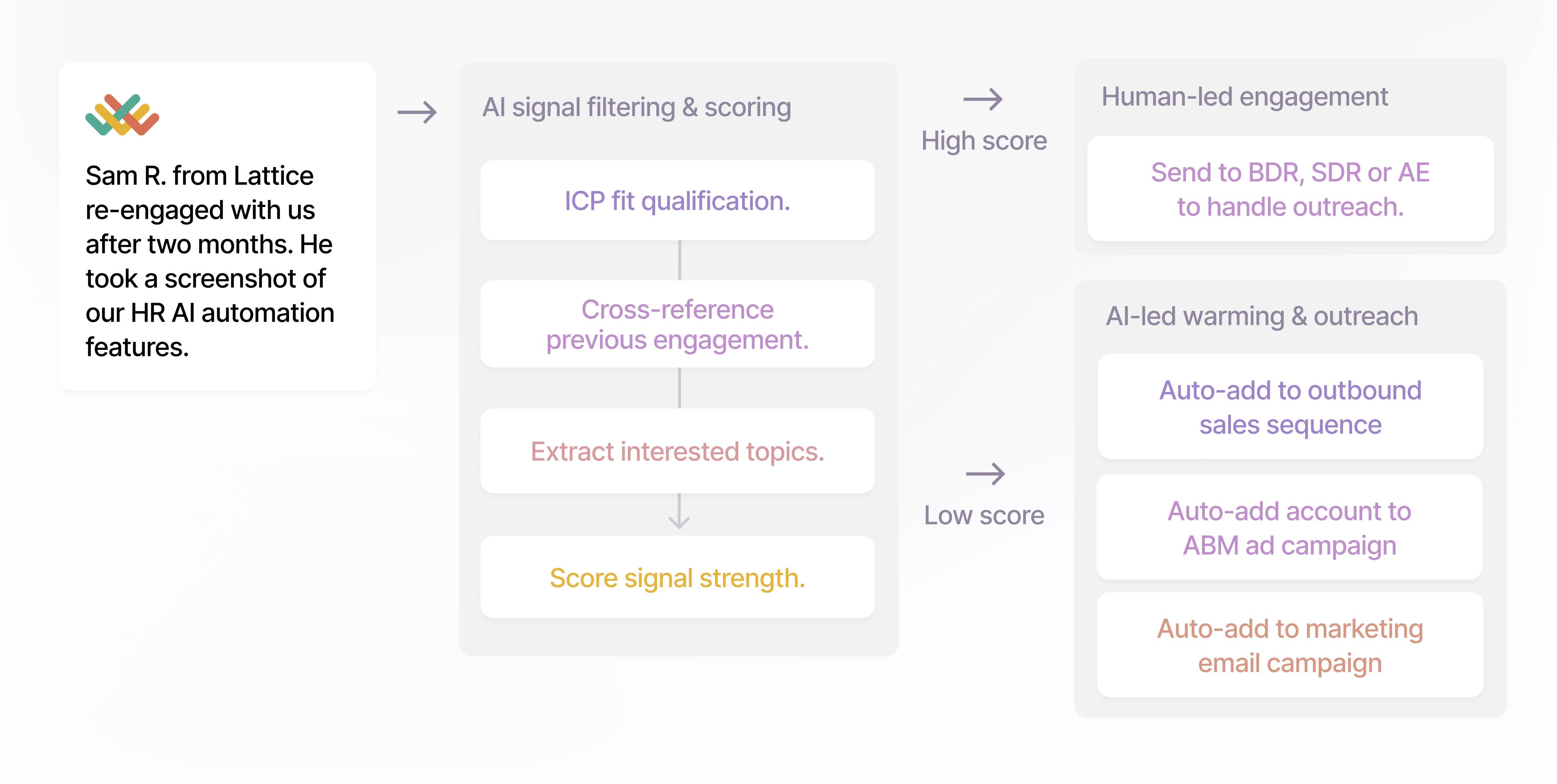
Recommended signals action flow. Avina takes care of these steps out-of-the-box.
Craft Contextual, Personalized Outreach
Once you've determined it's the right time to reach out, you'll want to leverage the intel from the signal to send a message that will resonate.
Rather than referencing the buying signal directly (e.g., "I saw you looked at our case study on X"), which may sound a bit creepy, use what the signal tells you about their pain point to tailor your message in a natural, helpful way. For example, if a prospect showed interest in a specific case study, you might email them offering another resource related to that topic.
Here's a common framework for personalized outreach:
- Show insight into their pain points and context, based on the buying signal (e.g., "I know companies like yours often struggle with … ")
- Explain how your solution addresses that problem. If you want to avoid a hard sell, offer them helpful content that can be a value-add.
- End with a clear call to action, e.g., a meeting invite or offering a relevant demo
By aligning your message to what the buyer is thinking about, you transform outreach from a cold call into a warm, consultative touch.
Tip: Leverage Multiple Channels
Buyers have different preferences: some respond best to emails, others to LinkedIn messages, still others to phone calls.
Sopro's B2B prospecting research found that 73% of B2B buyers prefer email as their primary vendor contact channel, though LinkedIn and phone outreach meaningfully improve conversion when layered on top.
If a signal is particularly strong, consider a multi-channel approach.
For example, an SDR might email a resource and simultaneously send a short LinkedIn message (e.g., "Hi, saw you checked out our guide on Topic X. We actually helped Company X with that exact challenge. Happy to share what we learned.").
The LinkedIn touch reinforces your name and adds a human face to outreach. Just ensure consistency and don't overdo it to the point of feeling intrusive.
Use AI Assistance for Scale and Consistency
Capturing and acting on all these buying signals can seem overwhelming. But it doesn't have to be. AI-based tools can simplify this process by consolidating diverse signals into a single platform, providing your revenue team with actionable insights and AI-assisted actions.
In the past, reps had to manually scan CRM data, and marketing activity timelines, and news, piecing together information in dozens of Chrome tabs. Kudos to the sales teams that developed strict training and discipline to consistently perform, but it's hard to imagine even the best sales teams were not missing golden opportunities.
Imagine your sales reps starting every day with a fresh list of the strongest opportunities based on signals and fit. When a new buying signal comes through, they get a real-time notification and along with it, a phone number and pre-written message that incorporates relevant talking points about that signal.
When they need to qualify the account further, they have AI agents to do account research for them. With this information at hand, you can easily tweak, approve, and send, speeding up response time while keeping message quality high - all the time.
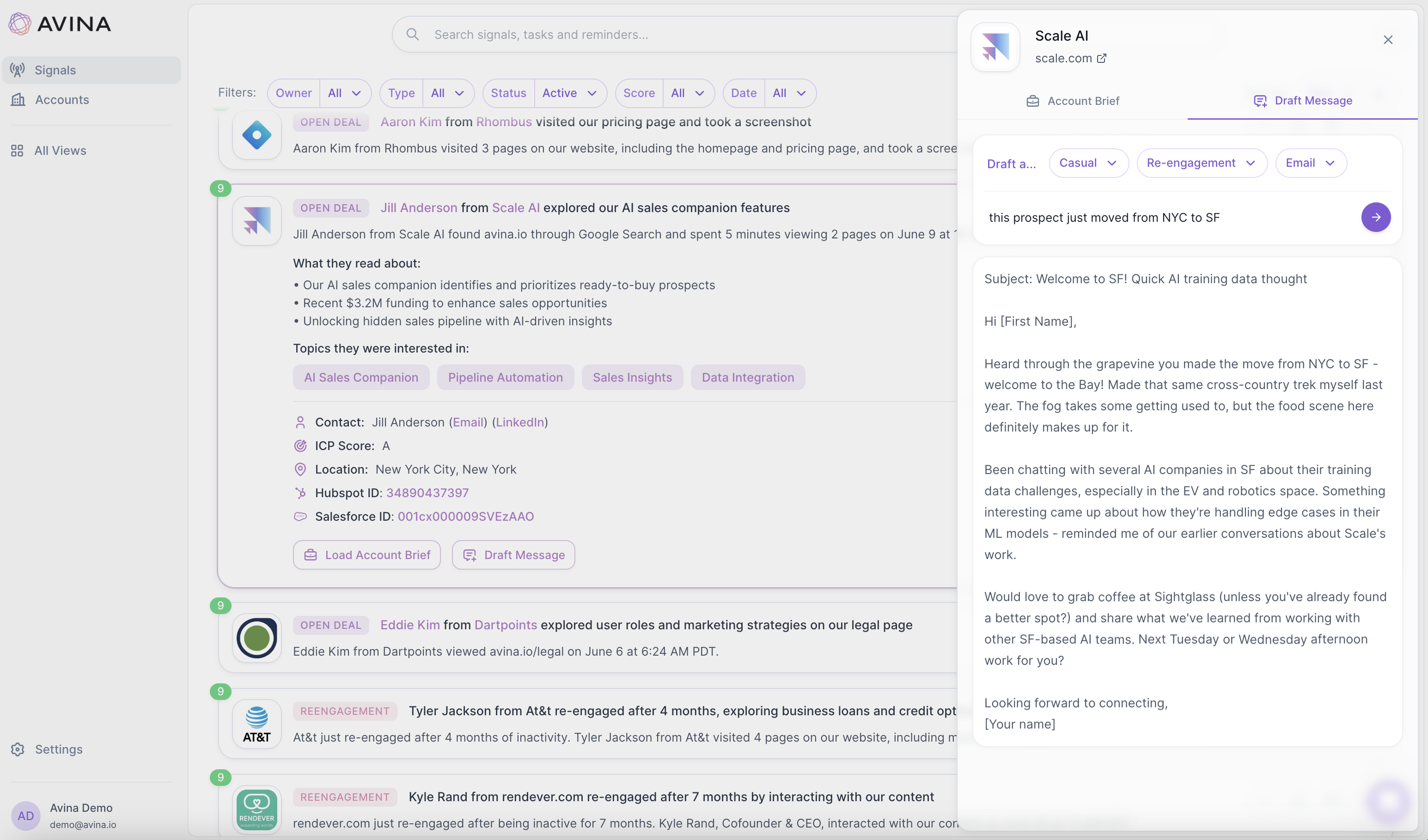
Example Avina dashboard with drafting and account research.
Even better, as you see which signals and outbound converts, you can refine your strategy over time.
Using AI to unify all signals, prioritize, and push actions into the CRM is faster, more reliable, and easy to scale. This frees up reps to do what they do best: building personal relationships and matching pain points with potential solutions.
We wrote a series on the Future of Revenue that dives into how modern AI sales tools are changing the game - check it out!
Avina is a signals-based GTM automation platform for B2B teams that uses cutting-edge artificial intelligence to convert data into revenue.
Ready to move from chaos to clarity? Book a demo.
Have questions, feedback, or ideas? Reach out to Avina at hello@avina.io.
What Our Customers Are Saying
"Avina has completely changed the way I work. Before, I felt like I was shooting in the dark to get responses, but now I have the highest propensity buyers being delivered to my doorstep, and I can focus on closing those deals." — James, Director of Strategic Partnerships, Ingenious (Case study)
"In sales, it's all about getting more quality at-bats. Products that help do better cold outbound are faster horses - Avina's warm inbound alerts is a car." — Ethan Pope, VP Revenue Operations, Nitrogen Wealth
Frequently Asked Questions

More from the blog


Give your team the edge they need.
Get started in just 30 min and unlock your hidden pipeline with Avina.